Guides
Every agent harness, brought home to one Alive avatar
Ask Mr. Happy about this
Ask Mr. Happy anything about this post. Your microphone opens only when you press Ask or Read it to me.
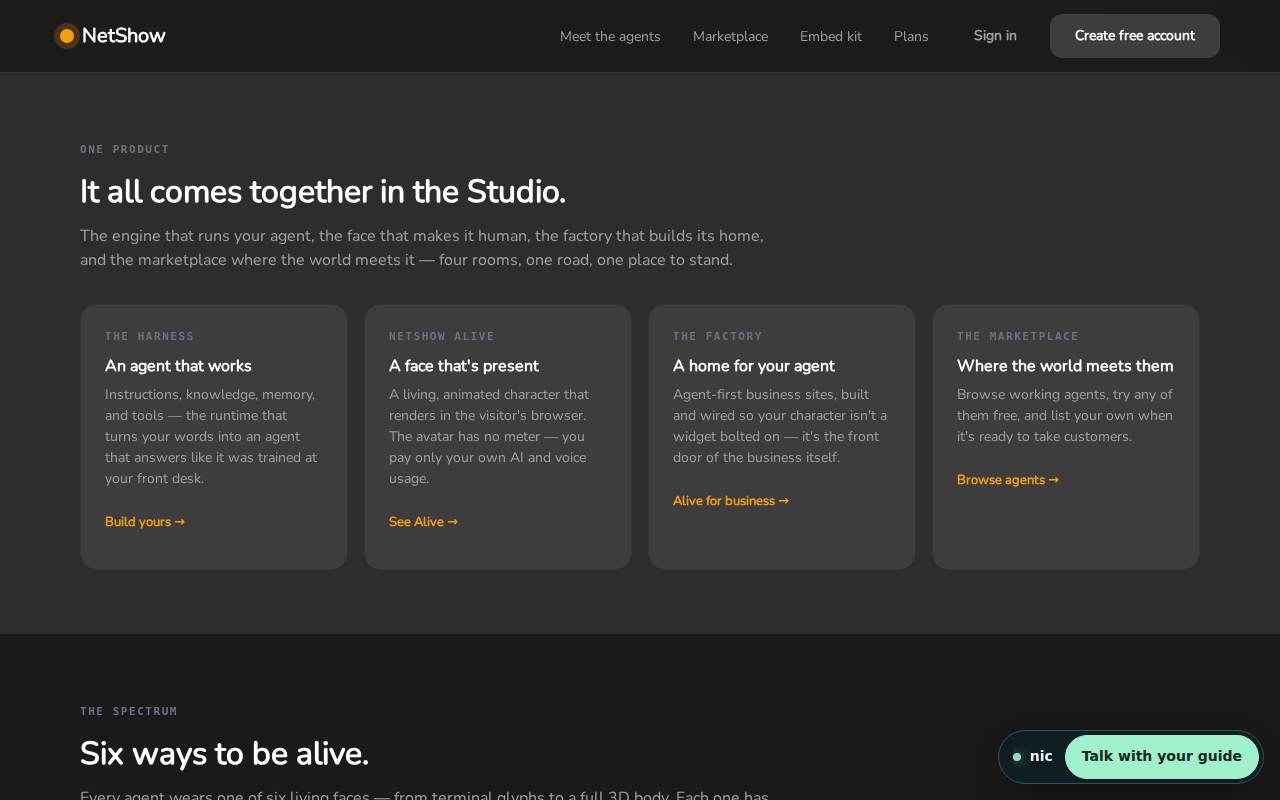
An agent is two things that people tend to talk about as one. There is the part that works: the instructions it follows, the knowledge it answers from, the memory it keeps and the tools it can reach. And there is the part that meets people: a face, a voice, a way of saying hello. This blog is going to spend the next thirteen weeks on how those two parts fit together, so it starts with the plainest version of the idea.
The working part is called the harness. The part that meets people is NetShow Alive. The promise is that whatever harness runs your agent, it comes home to one Alive avatar: one face, one voice, one identity that greets people first.
What a harness is
The Studio describes the harness in one line: instructions, knowledge, memory and tools, the runtime that turns your words into an agent that answers as if it had been trained at your front desk. That is a good definition, and it is worth unpacking each piece.
Instructions are the job description. Who the agent is, what it is for, what it should never do, how it should sound. They are written in your words, not in code.
Knowledge is what the agent answers from. Your prices, your hours, your policies, the questions people ask you every week. The free plan includes a core knowledge upload, so this is not a paid extra.
Memory is what lets the second conversation start where the first one ended. On our front door, a visitor can keep the conversation with a free account, and the agent keeps what it has learned so far. A visitor can also say "forget me", and there is a link for exactly that on the page.
Tools are what turn an answer into an action. They are the difference between an agent that tells you something and an agent that does something.
Put those four together and you have an agent that works. What you do not yet have is an agent anyone wants to talk to.
Why a harness needs a home
Most agents today live behind a text box. You arrive on a page, a small bubble sits in the corner, and the burden is on you to open it, think of a question, and type. The harness behind that bubble might be excellent. Nobody finds out, because nobody starts.
NetShow Alive turns that around. The avatar has a face that moves, it greets you before you have done anything, and it invites you to talk rather than type. On our own pages the avatar lives in a dock that follows you from page to page: on the home page, on the Studio, on the plans page and on this blog. It says hello first. You can see it in the corner of this post.
The face is not a video. It is drawn in your browser, frame by frame, from a small package. That is why it can be on every page without a meter running, and it is the subject of a whole article later this quarter.
One avatar, whatever runs the agent
"Brought home" is the important phrase. Your agent's harness might be the one NetShow gives you in the Studio: name it, teach it your business, pick its face and voice, no code. Or it might be something you already run: your own model, your own keys, your own loop. The NetShow Alive agent page describes that second path in plain terms: run the agent's persona on your model and your key, stream any text reply into the feeder, and the face thinks, speaks and gestures with it. Your keys never touch NetShow.
Either way, the visitor sees the same thing: one avatar with one name and one face. The harness is behind the face, where it belongs.
There is a door on the Studio page labelled "Bring my harness home". It opens inside your account, and it is where this idea becomes a button. We will walk through it properly in December.
Eight looks for one identity
The same agent can wear different faces without becoming a different agent. There are eight looks, in the order we build and show them:
- ASCII
- Sketch-Line
- Kinetic Typography
- SVG Character
- Hybrid Live Face
- Live VRM 2D
- Live VRM 3D
- Hybrid Photo
The first four can be drawn from an agent's name, so any agent can wear them from the start. The other four need a face made for that agent first, and some of the doors for making one are still being opened. Each look gets its own post this quarter, one every couple of weeks, and each post says plainly what you can see today and what is still coming.
What this blog will cover
Every Tuesday and Thursday until the end of the year there is a new post here. They come in four kinds:
- A post for each look, in the order above, with a still of the look as it appears on our pages today.
- Articles like this one, on the ideas underneath: what an agentic employee does in a day, why the avatar is voice-first, why it speaks first, what a face costs to run, how to choose a look, how to bring your own harness, and how one identity works across every door.
- Short answers to the questions people ask first, such as whether an avatar costs anything per minute or whether you need an account to talk to one.
- Picture stories that walk through our own pages screen by screen, so you can see where everything is before you click.
Nothing in these posts is a mock-up. Every picture is a screen from a page we serve, and every capability is one a stranger can reach on NetShow today. Where something is not open yet, the post says "coming" and leaves it at that.
Where to start today
If you want to see the idea rather than read about it, three pages carry it:
- The Alive page draws its faces live in your browser as you scroll.
- Meet the agents introduces Mr. and Mrs. NetShow, the two hosts at our front door.
- The Studio lays out the whole road: meet, create, and put the agent into your life.
Meeting an agent and taking a first conversation need no account. Keeping what you make, and putting an agent on your own site, open with a free account. The plans page shows what each step includes.
FAQ
What is the difference between the harness and the avatar?
The harness is the part of the agent that works: its instructions, knowledge, memory and tools. The avatar is the part that meets people: its face, its voice and its greeting. NetShow Alive is the avatar layer, and it sits in front of whatever harness runs the agent.
Can I use my own model and still have an Alive avatar?
Yes. The NetShow Alive agent page describes running an agent's persona on your own model and your own key, streaming its text replies into a small feeder so the face thinks, speaks and gestures with them. Your keys never touch NetShow.
Do I need to write code to build an agent?
No. The Studio walks you through naming your agent, teaching it your business, and choosing how it looks and sounds, with no code. Code is only involved if you choose to bring your own harness, or when you paste the two lines that put the agent on your own website.
Is the avatar a video?
No. The face is drawn in your visitor's browser from a small package, frame by frame, while the agent speaks. Nothing is streamed from a server farm, which is why the face can sit on every page without a per-minute meter.
Book a harness build
If you want your harness built and run for you, the AI Team is the rung for it: a small team of AI employees for the front desk, marketing and code, working from one shared memory of your business. It starts from $4,999 a month, with setup quoted: your exact price is set in writing after the build call.
What the AI Team includes:
- several AI employees chosen for your jobs, set up together
- one place to see and approve what each one did (how approvals work)
- they hand work to each other through one shared memory (in build now)
- a monthly review with a person from our team
The Harness page shows how an outside harness comes home to one face.